
Last Updated: October 29, 2026
Quick Summary
You manage forex trading emotions by front-loading decisions before the trade, not during it. Run a pre-trade checklist covering your written plan, fixed risk rule, stop-loss and physical state, and skip the trade if any answer worries you. A 60-second physiological reset helps when the urge to click hits.
- Your brain treats a live trade as a threat, so build rules that override the reflex.
- Close the platform after a revenge trade and do not reopen it for a set time.
- Score each trade on rule adherence separately from profit, since a winning trade that broke rules is a bad trade.
- Our approach uses strict 0.5% risk rules so one loss stays a small, planned cost.
- Write a daily loss limit and a trade limit into your plan, like stopping after two losses in a day.
Table of Contents
- Why Your Brain Fights You Every Time You Open a Trade
- How to Control Emotions While Trading: The Pre-Trade Checklist
- Identifying Your Emotional Triggers Before They Cost You
- How to Stop Revenge Trading: Breaking the Cycle
- Risk Management as Your Emotional Buffer
- Building Your Forex Trading Plan Template
- Forex Trading Journal Examples That Reveal Your Patterns
- Managing Fear and Greed When the Market Moves Fast
- Book a Call to Build Your Emotional Discipline Plan
- Frequently Asked Questions
Why Your Brain Fights You Every Time You Open a Trade
Your brain treats a live trade like a threat. That is the core problem behind every bad decision in forex trading emotions, and it explains why discipline feels so hard.
When you enter a position, your brain’s threat system switches on. Losses register as danger, not as numbers on a screen. So you freeze, or you click too fast.
A trader may know the setup. Then price moves against them by a few pips, and the plan disappears.
Here is the uncomfortable truth most guides skip: your brain is not broken. It is doing its job. It is protecting you from loss. The job of a trader is to build rules that override that reflex.
Three things happen under pressure:
- Loss aversion makes a small drawdown feel like a real threat.
- Confirmation bias pushes you to hunt for reasons your trade will still work.
- The sunk cost fallacy keeps you in a losing trade because you already committed.
Your physical state matters too. Poor sleep, low blood sugar, and stress all lower self-regulation.
Forex trading emotions are the predictable output of a brain under threat, not a character flaw. Once you accept that, you can build systems around it instead of relying on willpower.
How to Control Emotions While Trading: The Pre-Trade Checklist
You control emotions while trading by front-loading decisions before the trade, not during it. A short checklist removes the choices that pressure forces you to make badly.
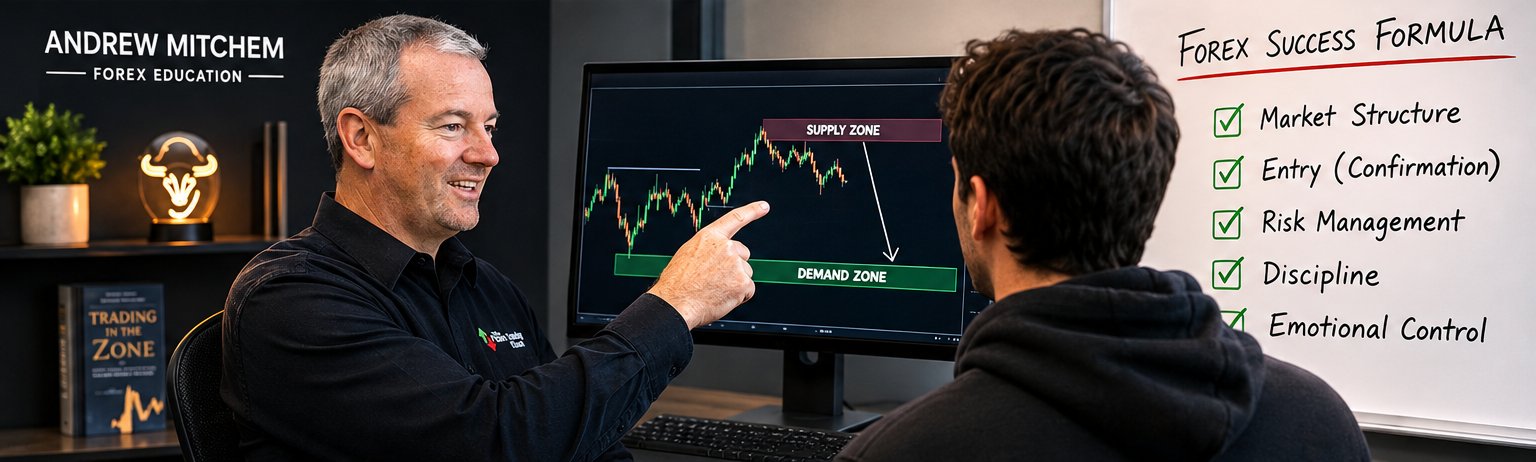
Focused trader reviewing a pre-trade checklist to manage forex trading emotions at a sunlit desk
Run this before every entry:
- Is this trade on my written plan, or am I improvising?
- Is my position size within my fixed risk rule?
- Where is my stop-loss, and do I accept the loss if it hits?
- Have I had a losing trade in the last hour? If yes, stop.
- Am I tired, angry, or rushed right now?
- Is my trade entry based on my setup, or on market sentiment I saw online?
If any answer worries you, do not trade. Skipping a bad trade costs nothing. Taking one costs capital.
A common mistake is treating the checklist as a formality. The traders who improve are the ones who actually stop when a box fails.
The 60-Second Physiological Reset
When you feel the urge to click, pause for one minute. Breathe slowly, relax your shoulders, and unclench your jaw.
This is not soft advice. It is stress management at the physical level.
Use it after any sharp loss. Then walk away from the screen before you decide anything.
Run this checklist before every entry and skip the trade if any answer worries you.
|
Check |
Question to ask |
|---|---|
|
Plan |
Is this trade on my written plan, or am I improvising? |
|
Size |
Is my position size within my fixed risk rule? |
|
Stop-loss |
Where is my stop-loss, and do I accept the loss if it hits? |
|
Recent loss |
Have I had a losing trade in the last hour? If yes, stop. |
|
State |
Am I tired, angry, or rushed right now? |
|
Setup |
Is my entry based on my setup, or on market sentiment I saw online? |
Identifying Your Emotional Triggers Before They Cost You
Most traders cannot name what sets them off, so they cannot defend against it. Your triggers are specific, repeated, and predictable once you look for them.
Common triggers include:
- A string of two or three losses in a row
- Watching a trade go into profit, then reverse
- Missing a move you planned but did not take
- A large position that suddenly moves against you
- Trading while distracted by your phone
That last one is worth its own note. Distraction is a silent trigger, and it is worth reading about how your phone is keeping you from becoming a better trader if you trade with notifications on.
The fix is to log triggers as they happen. Not later. In the moment, write one line: what happened, and what you felt.
Over a few weeks, patterns may appear.
How to Stop Revenge Trading: Breaking the Cycle
Revenge trading is the urge to win back a loss immediately, usually with a bigger position. It is the single most expensive habit in forex trading emotions, and it follows a fixed cycle.
The cycle looks like this:
- Loss. A planned stop-loss hits.
- Shame. You feel foolish or wronged.
- Urge. You want the money back now.
- Impulse trade. You enter with no setup, often larger.
- Bigger loss. The cycle deepens.
Breaking it needs a hard rule, not good intentions. Close the platform. Do not reopen it for a set time.
If you are stuck in this loop and want a structured path out, our guide on how to master trading discipline and consistency walks through the habits that replace the reflex.
The Post-Trade Emotional Audit
After each session, review your trades for emotion, not just profit. This is the step most traders skip, and it is where the real learning sits.
Ask three questions per trade:
- What was I feeling at entry?
- Did I follow my plan exactly?
- If I broke a rule, what triggered it?
Score each trade on performance metrics and on rule adherence separately. A winning trade that broke every rule is a bad trade. A losing trade that followed the plan is a good one.
This audit can help you judge trades by process rather than outcome.
Risk Management as Your Emotional Buffer
Risk management is one tool a trader can use when managing emotions. When your risk per trade is small and fixed, a loss may feel more manageable.
The logic is simple. If one loss can wipe out a week, every trade feels like a threat. If one loss is a small, planned cost, your brain stays calm. That calm is what protects capital preservation.
Our approach uses strict 0.5% risk rules.
Practical rules that work:
- Fix your risk per trade.
- Set stop-loss orders before entry, every time.
- Use consistent position sizing based on that fixed risk.
- Track drawdown.
Building Your Forex Trading Plan Template
A forex trading plan template turns your intentions into written rules. The plan is your defense against the emotions that show up mid-trade.
Your template should cover:
- Your setup: what a valid trade looks like, and what does not.
- Entry and exit rules: fixed, written, no judgment calls.
- Risk per trade: one number, applied every time.
- Session times: when you trade, and when you stop.
- Rules for stopping: a daily loss limit and a trade limit.
Write it in plain language. Then keep it beside your screen. You can also browse forex trading resources for practical tools to build it.
The plan should be specific. “Trade with discipline” is not a rule. “Stop after two losses in a day” is.
Forex Trading Journal Examples That Reveal Your Patterns
A trading journal can help you look for patterns in your entries.
A strong journal entry includes:
- Date, pair, and timeframe
- Trade setup and why you took it
- Position size and risk
- Emotion at entry and exit
- Whether you followed the plan
- One lesson from the trade
Here is a simple example of what a useful entry looks like:
Setup: pullback to support on the 4-hour. Risk within rule. Emotion at entry: calm. Exit: stop hit. Followed plan: yes. Lesson: nothing to fix. Good trade.
Now compare it to a bad one:
Setup: none, entered after a loss. Risk doubled. Emotion: angry. Followed plan: no. Lesson: revenge trade, cooling-off rule broken.
The second entry is the valuable one. It shows the trigger, the broken rule, and the fix.
Managing Fear and Greed When the Market Moves Fast
Fear and greed are common topics in discussions of trading emotions. Traders may find it useful to consider how emotions affect their decisions.
The Physiology of Fear and Greed
- Heart rate: A sudden spike above your resting rate often precedes an impulsive click. Use a smartwatch or fitness tracker to notice this in real time.
- Breathing pattern: Shallow, rapid breathing is a reliable sign of stress. Deliberately slow your exhale to twice the length of your inhale for 60 seconds.
- Muscle tension: Clenched jaw, raised shoulders, or a tight grip on the mouse are physical cues that fear or greed is taking over.
Practical Tactics for Fear
Another tactic: set a profit target and a trailing rule before entry, so the decision to exit is already made. When a trade moves fast in your favor, do nothing for sixty seconds. Let the plan act, not the excitement. If you feel the urge to close early, check your physiology first, are your shoulders tense? Is your breathing shallow? If so, perform the 60-second reset described earlier before touching the mouse.
Practical Tactics for Greed
Market volatility is not the enemy. Your reaction to it is what costs money. The traders who last are the ones who keep their rules steady when the screen goes wild, and who monitor their body as closely as their charts.
Book a Call to Build Your Emotional Discipline Plan
Reading about discipline is easy. Building it under live pressure is the hard part, and it is where most traders stall.
At The Forex Trading Coach, our 90-day accelerator pairs a proven strategy with strict risk rules and expert mentorship.
You get a structured pathway with defined milestones and daily trade mirroring. Read Ryo’s trading story for his account of his trading journey.
If you are unsure where to start, book a call with our team. You can also join our free forex masterclass.
Frequently Asked Questions
How do I control my emotions while trading?
Start with a written pre-trade checklist that forces a pause before every entry. Set a hard rule that you will not click buy or sell until you have confirmed your stop-loss, position size, and reason for the trade. A brief pause before executing may help you reflect on your decision. The goal is not to feel nothing but to stop feelings from making the decision for you. A structured plan and a journal make this repeatable.
How can I stop revenge trading after a loss?
Revenge trading happens when you try to win back money immediately after a loss. After a losing trade, you could consider stepping away from the charts for a while. Write down what happened and whether your original trade setup was valid. If it was, the loss is just part of the process. If it wasn’t, you have found a rule to add to your plan. Logging the urge to re-enter helps you spot the pattern before it costs you.
What should I include in a forex trading journal?
A useful forex trading journal records more than profit and loss. Include the date and time, currency pair, your reason for entering, the trade setup, position size, stop-loss and take-profit levels, the outcome, and your emotional state before and after the trade. Add a short note on whether you followed your plan. Reviewing these entries can help you reflect on your decisions and consider whether to adjust your rules.
Is forex a skill or luck?
Trading involves uncertainty. Skills relevant to trading include applying risk management and following defined rules. Structured practice and mentorship are part of The Forex Trading Coach’s educational approach.
Your emotions will not disappear, and they do not need to. What changes is how much control they have over your clicks. Build the rules, review the trades, and get a coach who keeps you honest. Get started with The Forex Trading Coach and trade your plan, not your feelings.

The post Can You Really Master Forex Trading Emotions? appeared first on Online Forex Trading Course.
* This article was originally published here


No comments:
Post a Comment